AI in web development is changing how websites are planned, designed, coded, tested, optimised, and maintained. In 2026, artificial intelligence is no longer limited to generating small code snippets or answering programming questions. Modern AI tools can create website layouts, write code, analyse existing projects, generate content, fix bugs, build components, run tests, and support multi-step development tasks.
The biggest change is the move from simple AI assistance towards AI-powered development agents. Developers can now give an AI tool a goal and allow it to inspect a project, create a plan, modify multiple files, run commands, test the result, and make corrections. Google has described this broader shift as the rise of the “agentic web”, where AI agents are increasingly involved in both building and interacting with websites.
The adoption of AI in web development is also becoming mainstream. JetBrains reported in January 2026 that 90% of professional developers surveyed regularly used at least one AI tool for coding and development tasks, while 74% had adopted specialised AI developer tools such as coding assistants, editors, and agents.
This does not mean traditional web development has disappeared. HTML, CSS, JavaScript, databases, APIs, accessibility, security, SEO, and software architecture remain important. Instead, AI is changing how developers use these technologies and how quickly they can move from an idea to a working website.
What Is AI-Powered Web Development?
AI-powered web development is the use of artificial intelligence to assist or automate different parts of website and web application development. Instead of manually completing every development task, developers can use AI to generate code, analyse requirements, create designs, test functionality, write content, and troubleshoot problems.
AI in web development can be used at almost every stage of a project. A business owner can describe a website idea to an AI website builder and receive a complete starting design. A designer can use AI to generate layouts or interface concepts. A developer can ask an AI coding assistant to create a React component or troubleshoot JavaScript. A development agent can work across an entire repository and complete a larger feature.
This creates a new development workflow where humans provide goals, requirements, context, and judgement while AI handles an increasing amount of implementation work.
The important point is that AI does not simply replace coding. It changes the relationship between people and code.
How AI Is Changing Web Development in 2026
AI in web development is creating changes across design, coding, testing, content, SEO, security, and project management. Some changes are already common, while others are developing rapidly as AI agents become more capable.
1. AI Is Making Website Creation Faster
One of the most visible effects of AI in web development is the speed at which a website can be created.
Traditional website development may involve separate stages for planning, wireframing, design, content creation, front-end development, back-end development, testing, and deployment. AI can accelerate several of these stages.
A user can describe a website in natural language, such as:
“Create a modern website for a digital marketing agency with Home, About, Services, Case Studies, Blog, and Contact pages.”
An AI website builder can then generate an initial structure, design, content, images, navigation, and calls to action.
The first version may still require editing, but the developer or website owner is no longer starting with a blank screen.
This is particularly useful for small businesses, freelancers, startups, bloggers, and entrepreneurs who need a professional website without a large development budget.
AI Website Builders Are Becoming More Powerful
AI website builders are evolving from simple template generators into conversational development platforms. Instead of selecting a template and manually editing every section, users can increasingly describe what they want and ask AI to make changes.
AI in web development therefore makes website creation more accessible to people who have little or no coding experience.
Platforms such as Wix, Hostinger, Framer, Webflow, and AI-native development platforms are combining natural-language generation with visual editing and other website features. Webflow’s AI site builder, for example, can generate a multi-page website from a description and its broader AI features extend into content and development workflows.
This does not eliminate the need for good design. It means designers and website owners can spend more time refining the user experience rather than manually creating every basic element.
2. AI Is Changing the Role of the Web Developer
AI in web development is also changing what developers spend their time doing.
In the past, developers could spend hours writing repetitive code, creating standard components, debugging common errors, or searching documentation for implementation details. AI can now handle some of these tasks much faster.
This means developers can increasingly focus on:
- Architecture
- Product requirements
- User experience
- Security
- Performance
- Testing strategy
- Technical decisions
- Code review
- Business logic
- AI workflow management
The change is already visible in professional development environments. Stack Overflow’s 2025 Developer Survey found that 80% of developers were using AI tools in their workflows, but trust in AI output had fallen to 29%.
This suggests that developers are not simply handing all work to AI. They are using AI while still recognising the importance of human review.
The developer of 2026 therefore needs more than coding ability. They also need to understand how to instruct AI, evaluate generated code, identify mistakes, and make sound technical decisions.
3. AI Coding Agents Are Moving Beyond Autocomplete
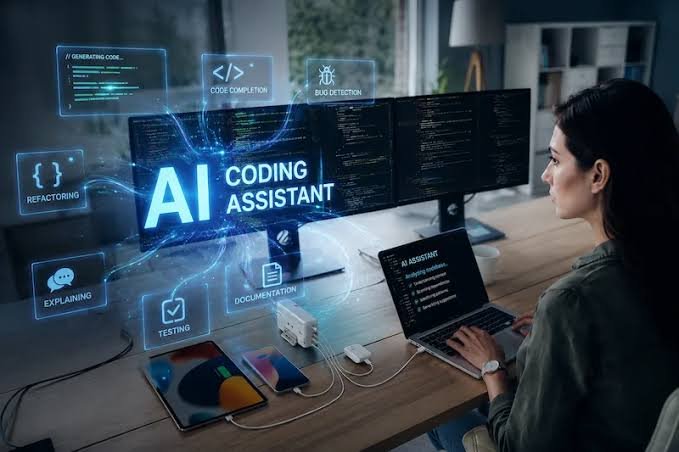
AI in web development is increasingly moving from autocomplete towards AI coding agents.
Traditional AI coding assistants suggest code while the developer works. AI coding agents can take a larger objective and perform multiple steps.
For example, instead of asking:
“Write a login form.”
A developer might tell an AI agent:
“Add authentication to this application. Create login and registration pages, connect them to the existing API, add validation, update routing, create tests, and fix any errors.”
The agent can inspect the project and work through the task.
GitHub’s current agent capabilities include repository research, planning, code changes, testing, and pull-request workflows. OpenAI’s Codex also supports broader software engineering tasks such as feature development, refactoring, migrations, and testing.
This is one of the biggest changes in AI in web development because the AI is no longer simply suggesting what the developer should type. It can increasingly perform parts of the development process itself.
4. Vibe Coding Is Making Development More Accessible
Vibe coding has become another important part of AI in web development. It allows users to describe an application or website in natural language and let AI generate much of the implementation.
A beginner might say:
“Build a responsive restaurant website with an online menu, reservation form, customer reviews, location map, and mobile navigation.”
The AI can create an initial application, after which the user can continue giving instructions.
This approach can be especially useful for prototypes and small projects. It allows people to test ideas without first learning every programming language.
However, vibe coding does not mean technical knowledge is no longer useful. Developers still need to understand whether the generated code is correct, secure, maintainable, and suitable for production.
Stack Overflow reported that nearly 72% of developers surveyed in its 2025 survey said vibe coding was not part of their professional work. This is an important reminder that AI-generated applications still require careful review, especially for serious production systems.
5. AI Is Changing Web Design
AI in web development is also affecting the design process.
AI tools can generate website layouts, colour combinations, typography suggestions, interface components, images, icons, and visual concepts.
A designer can provide a description such as:
“Create a modern SaaS landing page for an AI productivity platform. Use a clean layout, strong typography, subtle animations, feature cards, customer testimonials, pricing, and a prominent signup button.”
AI can produce a starting design that the designer can then modify.
This can reduce the time required to explore different concepts.
However, AI-generated design can also become repetitive. Many AI-generated websites use similar layouts, gradients, cards, buttons, and typography patterns.
Professional designers therefore still have an important role in creating a distinctive visual identity.
The future is likely to involve AI generating options while designers make the final creative decisions.
6. AI Is Improving Website Content Creation
AI in web development is not limited to programming and design. Content creation is another major area of change.
AI can help generate:
- Homepage copy
- Product descriptions
- Blog introductions
- FAQs
- Meta descriptions
- Email forms
- Calls to action
- Landing page copy
- Image alt text
- Documentation
- Help articles
This can make website development faster because content no longer has to wait until the design and development stages are complete.
However, AI-generated content should be reviewed carefully. Generic content can make a website sound like every other website on the internet.
Businesses should add original information, real experience, specific examples, accurate claims, and useful insights.
AI should help produce content faster, but human expertise should determine what the content actually says.
7. AI Is Changing SEO for Websites
AI in web development is also influencing search engine optimisation.
AI tools can help developers and marketers identify keywords, create content structures, generate metadata, improve internal linking, analyse pages, and identify technical SEO issues.
AI can also help developers understand search intent before creating a page.
For example, instead of simply targeting “AI website builder,” a developer can ask AI to identify different search intents around the topic, such as:
- Best AI website builders
- AI website builder for beginners
- Build a website with AI
- AI website development tools
- AI website builder without coding
This can help create a stronger content strategy.
At the same time, the rise of AI search means websites increasingly need to be useful and understandable not only to traditional search engines but also to AI-powered discovery systems.
A 2026 industry report on AI website development describes generative engine optimisation as an emerging discipline as AI systems become an increasingly important discovery channel.
For website owners, this means structured information, clear answers, strong expertise, and trustworthy content are becoming even more important.
8. AI Is Improving Testing and Debugging
Testing is another area where AI in web development can save developers significant time.
AI tools can generate unit tests, identify potential edge cases, analyse error messages, and help reproduce bugs.
For example, a developer can provide an error and ask:
“Find the likely cause of this error, explain it, suggest a fix, and create a test that prevents the problem from returning.”
An AI coding agent may be able to inspect the relevant files, implement a fix, run tests, and make further changes if something fails.
This creates a more iterative development cycle.
However, developers should not assume AI-generated tests are complete. Tests themselves can contain mistakes or fail to cover important scenarios.
Human review remains important for critical applications.
9. AI Is Making Prototyping Much Faster
AI in web development is particularly powerful for prototypes.
A startup founder with an idea for a SaaS product can use an AI development tool to create a working demonstration before hiring a full development team.
For example, a founder could create:
- A dashboard
- User registration
- A pricing page
- A database
- Basic authentication
- A customer profile
- An analytics interface
The prototype can then be shown to potential customers.
This allows businesses to test product-market fit before investing heavily in a full production application.
AI does not eliminate the need for professional development when a product scales. It simply makes early experimentation faster and cheaper.
10. AI Is Changing the Way Developers Learn

AI in web development is also changing education.
Developers can ask AI to explain programming concepts in different ways depending on their skill level.
A beginner can ask:
“Explain JavaScript promises like I am completely new to programming.”
An experienced developer might ask:
“Compare JavaScript promises, async/await, and reactive programming for a high-concurrency application.”
AI can also help developers learn unfamiliar frameworks and programming languages.
Stack Overflow reported in 2026 that 64% of developers surveyed were using AI to learn, up from 44% in 2025 and 37% in 2024.
This shows that AI is becoming an important learning companion for developers.
The challenge is ensuring that developers do not become dependent on AI without developing fundamental technical knowledge.
AI Is Increasing the Importance of Verification
One of the most important changes in AI in web development is that verification is becoming more important, not less important.
AI can generate code quickly, but fast generation does not guarantee correctness.
Stack Overflow’s research highlights this trust problem. Its 2025 survey found that AI adoption was rising while trust in AI output was falling, with developers reporting frustration with answers that were “almost right.”
This creates a new development principle:
Generate quickly, verify carefully.
Developers should review AI-generated code, run tests, check dependencies, inspect security-sensitive functionality, and validate the final user experience.
This is particularly important for websites handling payments, authentication, customer data, healthcare information, financial information, or other sensitive information.
AI and Website Security
AI in web development creates both opportunities and risks for website security.
AI can help identify vulnerabilities, explain security warnings, analyse dependencies, and generate security tests.
At the same time, AI-generated code can introduce vulnerabilities if developers accept it without review.
AI coding agents also have greater access to development environments than traditional chatbots. An agent may be able to read files, execute commands, install packages, or modify repositories.
That makes permissions extremely important.
Developers should limit access, protect secrets, avoid exposing sensitive credentials, use version control, and review important agent actions.
The more autonomous the AI system becomes, the more important security controls and human oversight become.
AI Is Changing Website Performance Optimisation
AI in web development can also help improve website performance.
AI tools can analyse code and identify potential problems such as:
- Large JavaScript bundles
- Unoptimised images
- Unnecessary dependencies
- Inefficient database queries
- Poor caching
- Render-blocking resources
- Repeated API calls
Developers can then ask AI to suggest improvements.
AI can also help generate responsive components and identify areas where a website may perform poorly on mobile devices.
However, performance still needs to be measured using real tools and real-world testing. AI suggestions should not replace performance benchmarks.
AI Is Creating New Development Workflows
The traditional development process is increasingly becoming a collaboration between humans and AI.
A modern workflow might look like this:
Idea → AI planning → Design generation → Code generation → AI testing → Human review → Deployment
Developers may use several AI tools throughout this process.
For example, one tool might generate the design, another might write the code, an AI agent might implement a feature, and another system might help review the code.
JetBrains found that 74% of professional developers had adopted specialised AI developer tools by January 2026, demonstrating how quickly AI is becoming part of everyday development workflows.
This means developers increasingly need to manage AI tools as part of their development environment.
Will AI Replace Web Developers?
AI in web development will automate many tasks, but that does not mean web developers are becoming unnecessary.
Instead, the role is changing.
AI is particularly good at generating repetitive code, creating variations, explaining technical information, and completing well-defined implementation tasks.
Humans remain important for:
- Product strategy
- Architecture
- Business requirements
- Security decisions
- User experience
- Accessibility
- Complex debugging
- Technical leadership
- Quality assurance
- Long-term maintenance
Recent industry evidence also supports this more balanced view. For example, Paisabazaar reported that AI generates a large share of its new code, while its CTO said engineers remain necessary for refining, validating, and deploying that code.
The future of web development is therefore more likely to be developers working with AI than AI independently replacing every developer.
Skills Web Developers Need in 2026
AI in web development is changing which skills are valuable.
Developers should still understand HTML, CSS, JavaScript, frameworks, databases, APIs, Git, testing, accessibility, and security.
But they should also develop AI-related skills.
Important skills include:
- Prompt writing
- AI tool selection
- AI code review
- Agent management
- Testing AI-generated code
- Security validation
- Context management
- Automation
- System architecture
- Technical communication
The ability to tell an AI system exactly what needs to be built is becoming increasingly useful.
However, the ability to recognise when the AI is wrong may be even more valuable.
The Future of Web Development With AI
The future of AI in web development is likely to involve increasingly autonomous development systems.
Google’s 2026 web platform announcements point towards an “agentic web” where AI agents can build and interact with websites while browsers and web technologies evolve to support these new experiences.
This could lead to websites that are more interactive and personalised.
Instead of a website simply displaying information, an AI agent could help users complete tasks, compare products, fill out forms, organise information, or interact with services.
At the development level, AI agents may increasingly handle repetitive implementation and maintenance work.
This does not mean websites will become fully automated. Instead, human developers may spend more time defining requirements, reviewing results, designing systems, and managing AI-driven workflows.
Benefits of AI in Web Development
AI in web development provides several important benefits for businesses and developers.
Faster Development
AI can generate code, content, layouts, and components quickly, reducing the time required to create the first version of a website.
Lower Development Costs
Small businesses can use AI tools to handle tasks that previously required separate design, development, and content resources.
Easier Prototyping
Businesses can test website and application ideas before committing to a large development project.
Greater Accessibility
People without extensive programming experience can create websites and simple applications using natural-language instructions.
Faster Debugging
AI can analyse errors and suggest possible solutions, helping developers investigate problems more quickly.
Better Productivity
Developers can delegate repetitive tasks to AI and spend more time on architecture, product decisions, testing, and user experience.
Challenges of AI in Web Development
AI in web development also creates challenges that should not be ignored.
Incorrect Code
AI can produce code that looks correct but does not work correctly in every situation.
Security Risks
Poorly reviewed AI-generated code can introduce vulnerabilities.
Generic Designs
AI-generated websites can look similar if users rely heavily on default patterns.
Technical Debt
Rapid AI-generated development can create messy code if architecture and maintainability are ignored.
Overdependence
Developers who rely entirely on AI may lose the ability to understand or troubleshoot their own code.
Trust Issues
Developers are increasingly using AI while remaining cautious about its accuracy. Stack Overflow’s research clearly shows this growing gap between adoption and trust.
The solution is not to avoid AI. It is to use AI with proper review, testing, security, and technical judgement.
Must Read:
- AI Coding Agents vs AI Coding Assistants: What’s the Difference?
- Best AI Website Development Tools in 2026
- Vibe Coding in 2026: How to Build Websites and Apps With AI?
Final Thoughts:
How AI is changing web development in 2026 is ultimately a story about increased speed, accessibility, automation, and a changing role for developers. AI can now help with website design, code generation, debugging, testing, content creation, SEO, prototyping, and application development.
The biggest transformation is the movement from simple AI coding assistance towards AI agents that can complete larger, multi-step development tasks. This is making it possible to move from an idea to a working website or application much faster than before.
At the same time, AI does not remove the need for human expertise. The growing use of AI has created an equally important need for verification, security, testing, architecture, and quality control. Developer surveys show widespread adoption alongside declining trust, making human review a central part of responsible AI-assisted development.
For businesses, AI can reduce the barrier to creating websites and digital products. For beginners, it can make learning and experimentation easier. For experienced developers, it can reduce repetitive work and increase productivity.
The most successful approach in 2026 is not to choose between humans and AI. It is to combine the strengths of both. AI can generate, automate, test, and accelerate, while humans provide strategy, creativity, judgement, security, and accountability.
That combination is likely to define the next stage of web development.