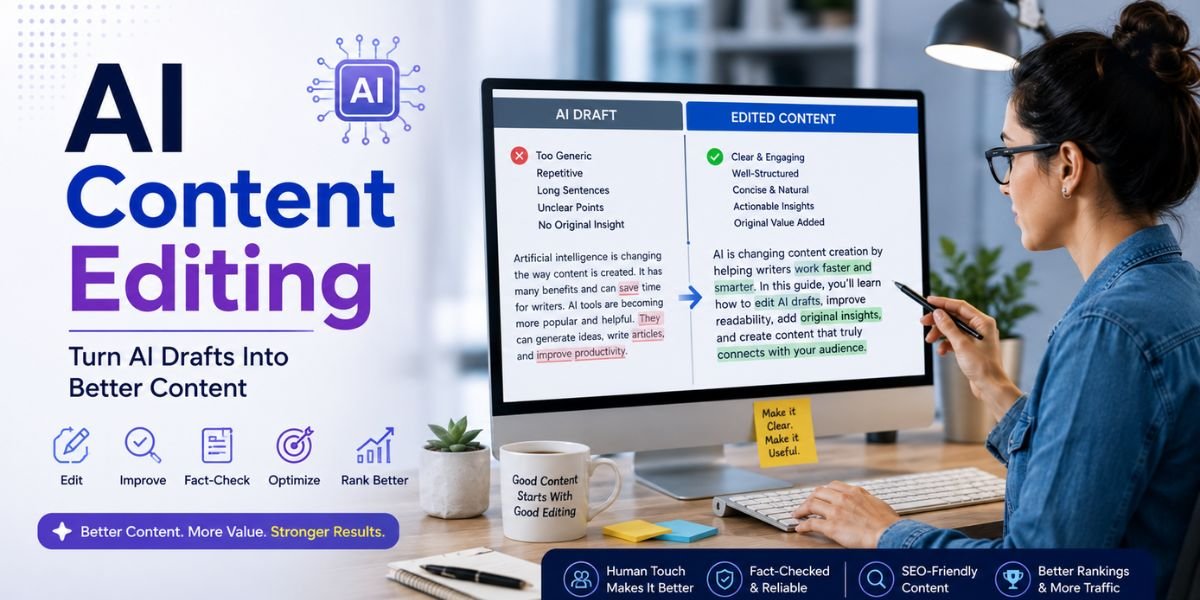
AI has made blog writing faster, but generating a draft is only the beginning. AI Content Editing is the process of taking an AI-generated draft and improving its accuracy, structure, readability, originality, tone, and SEO before publication.
An AI tool can create a complete article in minutes, but a fast draft is not automatically a high-quality article. AI-generated text may contain repeated ideas, generic statements, weak examples, outdated information, or sentences that sound unnatural. Effective AI Content Editing helps turn that first draft into useful content that readers can trust and enjoy.
Google’s guidance does not say that AI-generated content is automatically bad for Search. Google focuses on helpful, reliable, people-first content and says generative AI can be useful for research and adding structure to original content. However, generating many pages with AI without adding value can fall under Google’s scaled-content-abuse policy.
The goal, therefore, is not to hide the fact that AI helped with writing. The goal is to make the final article genuinely valuable.
What Is AI Content Editing?
AI Content Editing means reviewing and improving content created with an AI writing tool before it is published. The process can include rewriting sentences, checking facts, improving structure, adding original information, removing repetition, adjusting tone, optimising keywords, and making the article easier to read.
AI can create a useful starting point, but the editor decides what stays, what changes, and what needs additional research.
AI Draft vs Final Content
An AI draft is raw material.
Final content should be the result of several stages:
AI draft → research → fact-checking → human editing → SEO optimisation → final review → publication
This distinction is important for bloggers and website owners who want to publish content regularly without sacrificing quality.
Why AI Drafts Need Editing
AI-generated drafts can sometimes have problems such as:
- Repetitive wording
- Generic introductions
- Weak conclusions
- Unsupported claims
- Outdated information
- Incorrect statistics
- Vague explanations
- Unnatural transitions
- Excessive keyword repetition
- Similar sentence structures
- Lack of first-hand experience
- Lack of original examples
Some problems are obvious. Others become noticeable only when you read the article from the perspective of your target audience.
That is why AI Content Editing should be treated as an important part of the content workflow, not an optional final step.
Why AI Content Editing Matters for SEO
SEO is not simply about adding keywords to an article. Search engines need to understand the subject, while readers need a useful and satisfying experience.
Google’s current Search guidance recommends helpful, reliable, people-first content. It also says good content should be easy to read, well organised, unique, useful, and up to date.
Effective AI Content Editing helps achieve these goals by turning a generic AI draft into content with clearer information and stronger value.
AI Content Is Not Automatically Bad for Google
A common misconception is that Google automatically penalises every article written with AI.
Google’s guidance says its systems focus on the quality of content rather than simply how the content was produced. AI can be used appropriately when the resulting content is useful and meets Google’s quality standards.
The problem is not the tool itself.
The problem is low-value content.
If a website uses AI to create hundreds of pages that provide little original value, that approach can create SEO risks. Google’s current spam policy specifically includes using generative AI to produce many pages without adding value for users.
Start With a Full Read-Through
Before changing individual sentences, read the entire AI draft from beginning to end.
This first reading gives you an overall understanding of the article.
Do not immediately focus on grammar or keyword placement.
Instead, ask whether the article actually answers the reader’s question.
Ask These Questions
During your first review, ask:
- What is the main purpose of this article?
- Does the introduction match the title?
- Does every section contribute something useful?
- Is the information accurate?
- Are important points missing?
- Does the article repeat itself?
- Does it sound natural?
- Does it provide anything original?
- Would a reader feel satisfied after finishing it?
These questions can reveal major problems before you spend time polishing individual sentences.
Improve the Article Structure
One of the most useful parts of AI Content Editing is improving the structure.
AI can create a logical-looking outline, but the order is not always ideal for the reader.
A strong article should move naturally from the main problem to the solution.
For example, an article about AI writing tools might follow this structure:
What Are AI Writing Tools?
Give the reader a simple definition.
Why Are Bloggers Using AI Writing Tools?
Explain the practical benefits.
What Should You Look For?
Discuss important features.
Which Tools Are Worth Considering?
Provide comparisons or recommendations.
How Should You Use AI Safely?
Explain editing, fact-checking, and SEO.
Final Recommendations
Summarise the most useful options.
This structure prevents unrelated information from being mixed together.
Remove Sections That Do Not Help
AI can make an article longer without making it better.
During editing, identify paragraphs that:
- Repeat previous information
- Explain obvious concepts unnecessarily
- Add no new examples
- Contain vague statements
- Exist only to increase word count
Remove them.
Google explicitly says there is no preferred word count that guarantees better Search performance. The focus should be on satisfying the reader’s needs rather than reaching an arbitrary word target.
Rewrite Generic AI Introductions
AI-generated introductions can often sound similar.
Examples include phrases such as:
“Technology is changing the way we live and work.”
“In today’s fast-paced digital world…”
“As businesses continue to embrace artificial intelligence…”
These sentences are not always incorrect, but they often delay the useful information.
A better introduction gets to the actual problem.
For example:
“AI can create a blog draft in minutes, but publishing that draft without editing can leave you with repetitive, generic, or inaccurate content. AI Content Editing helps turn that first draft into an article that is clearer, more useful, and better suited to your audience.”
The second version tells the reader what the article is about immediately.
Make Sentences More Natural
AI writing can sometimes sound overly formal.
Consider this sentence:
“Businesses can leverage artificial intelligence technologies to facilitate the optimisation of their content creation workflows.”
A more natural version is:
“Businesses can use AI to make content creation faster.”
The second sentence is easier to understand.
Prefer Clear Language
During AI Content Editing, replace unnecessarily complicated words with simpler alternatives when the meaning remains the same.
For example:
- Utilise → Use
- Commence → Start
- Facilitate → Help
- Demonstrate → Show
- Approximately → About
- Numerous → Many
- Implement → Apply or use
This does not mean every article should use extremely simple language. The vocabulary should match the audience.
Technical readers may expect technical terminology.
Beginners usually benefit from clearer explanations.
Vary Sentence Length
AI-generated content can sometimes use a predictable rhythm.
Many paragraphs contain sentences of similar length and structure.
Human editing can improve this.
Use a mixture of short, medium, and longer sentences.
For example:
“AI is fast.
It can create an article outline in seconds. But speed does not guarantee accuracy, originality, or usefulness, so every important draft needs a careful editorial review.”
The variation feels more natural.
Use Active Voice
Active voice can make writing clearer.
Instead of:
“The article should be reviewed by the editor before publication.”
Write:
“The editor should review the article before publication.”
This is shorter and more direct.
Clear writing is also useful for SEO because it improves the reader’s experience.
Google’s SEO Starter Guide recommends content that is easy to read and well organised, with headings and sections that help users navigate the page.
Add Original Information

One of the most important steps in AI Content Editing is adding something that was not simply generated from a generic prompt.
AI can explain common knowledge.
Your job is to add value.
That could mean:
- First-hand experience
- Product testing
- Original research
- Case studies
- Screenshots
- Expert opinions
- Unique examples
- Industry observations
- Data analysis
- Personal recommendations
Google’s people-first content guidance asks whether content provides original information, research, analysis, insightful information, or substantial additional value.
Add Your Own Experience
Suppose an AI tool creates an article about AI website builders.
The draft might explain what an AI website builder does.
You can make it more useful by explaining what happened when you actually used one.
For example:
- How long did the setup take?
- What did the AI generate?
- Was the design easy to customise?
- Did the mobile version work properly?
- Were SEO settings available?
- What limitations did you encounter?
These details create a much stronger article.
Never Invent Experience
Do not ask AI to create fake first-hand experiences.
If you did not test a product, do not claim that you tested it.
If you did not interview an expert, do not present an invented quote.
If you did not conduct a study, do not publish fabricated research.
Originality should come from real information, not invented details.
Fact-Check Every Important Claim
Fact-checking is one of the most important parts of AI Content Editing.
AI tools can produce statements that sound convincing but are incorrect.
This is particularly important when writing about topics that change frequently.
What Should You Verify?
Pay particular attention to:
- Statistics
- Prices
- Dates
- Product specifications
- Company information
- Research findings
- Government policies
- Google Search guidance
- Technical instructions
- Health information
- Financial information
- Legal information
For current information, use reliable and authoritative sources.
For Google’s SEO policies, use Google’s official documentation.
For product specifications, check the manufacturer’s official website.
For research claims, check the original research whenever possible.
Do Not Trust Confident Language
One of the biggest AI editing mistakes is assuming that confident wording means accurate information.
It does not.
A sentence can sound authoritative and still be wrong.
During AI Content Editing, separate writing quality from factual accuracy.
A beautiful sentence is still a problem if the information is incorrect.
Improve Search Intent
A good AI draft can still fail if it does not satisfy search intent.
Search intent is the reason behind a search query.
For example:
“Best AI writing tools” usually suggests comparison or recommendations.
“How to edit AI content” suggests a tutorial.
“What is AI content editing?” suggests an informational explanation.
“AI writing tool pricing” suggests commercial research.
Make Every Section Support the Search Intent
If your target keyword is AI Content Editing, readers probably want to understand what it means and how to do it.
Your article should therefore explain:
- What AI Content Editing is
- Why editing matters
- How to edit an AI draft
- How to improve SEO
- How to fact-check
- How to add originality
- How to humanise the writing
- What mistakes to avoid
Do not fill the article with unrelated information simply because an AI tool suggested it.
Optimise Keywords Naturally
SEO optimisation should happen after the article is useful, not instead of making it useful.
Google’s Search Essentials recommends using words that people would use to find your content in prominent locations such as titles and main headings, while also using relevant terms naturally in descriptive locations.
Use the Focus Keyword
For this article, the focus keyword is:
AI Content Editing
It can appear naturally in:
- Title
- Introduction
- Relevant H2 headings
- Body content
- Meta title
- Meta description
- Image alt text when appropriate
Do not force the exact keyword into every paragraph.
Keyword stuffing makes writing unnatural.
Use Related Keywords
You can also naturally use related phrases such as:
- edit AI content
- AI-generated content
- AI writing
- AI content optimisation
- humanise AI content
- AI content editing tools
- improve AI-generated articles
- SEO content editing
- AI blog editing
- human editing
- content quality
- SEO-friendly content
These terms provide useful topical context without repetitive exact-match keywords.
Humanise the AI Draft
Humanising AI content does not mean trying to trick search engines.
It means making the writing clearer, more natural, specific, and useful.
Remove Repetitive Phrases
If the article repeatedly says:
“AI saves time”
you do not need to mention the same benefit in five different sections.
Explain it once properly, then move forward.
Add Personality
A website should have a recognisable voice.
You can make writing more distinctive through:
- Practical examples
- Clear opinions
- Personal observations
- Appropriate humour
- Specific recommendations
- Direct explanations
Your tone should match your audience.
A professional technology blog may sound different from a personal lifestyle blog.
Improve the Introduction and Conclusion
The introduction should explain the problem and promise a useful solution.
The conclusion should answer the main question without repeating the entire article.
Write a Useful Conclusion
A weak conclusion might say:
“In conclusion, AI Content Editing is an important part of modern content creation.”
That does not tell the reader much.
A stronger conclusion could say:
“Use AI to create the first draft, but do not treat that draft as finished content. Verify the facts, remove repetition, add original information, improve the structure, and optimise the article naturally for search. The result will be more useful to readers and more valuable to your website.”
That provides a clear takeaway.
Improve Headings and Subheadings
Headings help readers understand what each section contains.
During AI Content Editing, replace generic headings with descriptive ones.
Instead of:
“Benefits”
Use:
“Why AI Content Editing Improves Blog Quality”
Instead of:
“Tips”
Use:
“7 Ways to Improve an AI-Generated Blog Post”
Instead of:
“SEO”
Use:
“How to Optimise AI Content Without Keyword Stuffing”
Use H2 and H3 Correctly
Use H2 for major topics and H3 for supporting points.
For example:
H2: How to Edit an AI-Generated Blog Post
H3: Fact-Check the Draft
H3: Remove Repetition
H3: Add Original Examples
This creates a logical hierarchy and makes long-form content easier to scan.
Improve Internal Linking

Internal links can strengthen the relationship between relevant pages on your website.
If your website covers AI content, you could connect related articles about:
- AI writing tools
- Humanising AI content
- AI SEO
- Google AI Overviews
- AI blog writing
- AI website content
- SEO content writing
Google’s SEO guidance notes that links can help users and search engines understand and discover related content.
Use Descriptive Anchor Text
Instead of:
“Read more here”
use:
“learn how to humanise AI content”
The second option tells readers what they can expect after clicking.
Only add links when they are genuinely relevant.
Optimise the Meta Description
Your meta description should accurately explain what the page offers.
For example:
Meta Description: Learn how AI Content Editing can improve AI drafts with better SEO, readability, originality, fact-checking, structure, and human-focused writing.
Google’s SEO guidance recommends short, unique, page-specific meta descriptions that include the most relevant information about the page.
Do not write a description simply to repeat the keyword several times.
Improve Images and Alt Text
Visual content can make long blog posts easier to understand.
For an article about AI Content Editing, useful images could show:
- An AI draft before editing
- A revised version of the same paragraph
- An AI content workflow
- A content editing checklist
- SEO optimisation steps
- A writer reviewing an AI-generated article
Google recommends using high-quality images near relevant text and providing enough context for users to understand what an image represents.
Write Natural Alt Text
If an image shows someone editing an AI-generated article on a laptop, suitable alt text might be:
“Writer editing AI-generated blog content on a laptop”
Avoid stuffing keywords into alt text.
Use AI Tools During the Editing Process
AI can also help you edit AI-generated content.
This may sound strange, but AI can be useful for identifying problems that a human editor can then review.
Ask an AI tool to identify:
- Repeated ideas
- Long sentences
- Weak transitions
- Generic phrases
- Missing questions
- Potentially unsupported claims
- Grammar problems
- Sections that need more explanation
Then make the final decision yourself.
Use AI as a Second Editor
A useful workflow is:
Human creates strategy → AI creates draft → Human edits → AI reviews → Human approves
This gives you the benefits of AI without handing over complete editorial control.
Check Content for Originality
Before publishing, ask whether your article says anything that readers cannot easily find elsewhere.
If the answer is no, improve it.
Add a Unique Angle
For example, instead of writing another generic article about AI writing tools, you could compare them based on actual blogging workflows.
You could test:
- Article outline quality
- Research assistance
- Editing quality
- SEO features
- Long-form consistency
- Brand voice
- Ease of use
That creates a stronger reason to read your article.
Google’s people-first guidance asks whether content provides substantial value compared with other pages in search results and whether it offers original information or analysis.
Improve Content for AI Search
AI search experiences make content quality even more important.
Google says its AI experiences, including AI Overviews and AI Mode, rely on the same broad principles Google has long recommended: create unique, satisfying content, provide a good page experience, and make sure Google can access the content.
Answer Questions Directly
AI search often involves longer, more specific questions.
Structure relevant sections so the answer appears clearly.
For example:
Can AI-generated content rank on Google?
“Yes. Google does not automatically reject content simply because AI was used. The important issue is whether the content is useful, original, reliable, and created primarily to help people.”
Then provide supporting details.
This makes the article useful to both readers who want a quick answer and those who want a detailed explanation.
Create a Content Editing Checklist
A checklist makes AI Content Editing easier to repeat across multiple articles.
Content Quality
- Is the article accurate?
- Is the topic relevant?
- Does it satisfy search intent?
- Does it provide original information?
- Are the examples useful?
- Is anything repeated?
Readability
- Are sentences clear?
- Are paragraphs easy to scan?
- Is the tone natural?
- Are unnecessary words removed?
- Are transitions logical?
SEO
- Is the focus keyword relevant?
- Is the keyword used naturally?
- Are headings descriptive?
- Are internal links useful?
- Is the meta description accurate?
- Is image alt text descriptive?
Trust
- Are important claims supported?
- Is the author information accurate?
- Is first-hand experience genuine?
- Are sources reliable?
Final Review
- Does the article sound human?
- Does it provide enough value?
- Would you recommend it to someone?
- Does it answer the reader’s question?
- Is it ready to publish?
Common AI Content Editing Mistakes
Even editors can make mistakes when improving AI-generated content.
Changing Every Sentence
You do not need to rewrite everything simply because AI created the first draft.
Keep strong sentences when they work.
Edit where improvement is needed.
Replacing Words With Synonyms
Changing words like “important” to “essential” does not automatically make AI writing human.
Good editing improves meaning, structure, accuracy, and usefulness.
Over-Optimising Keywords
Do not turn a natural article into a keyword list.
SEO should support the reader experience.
Adding Fake Personal Stories
Never create fictional experience to make an article appear more authentic.
Keeping Content Too Long
If a paragraph adds no value, remove it.
Ignoring Accuracy
A natural-sounding incorrect claim is still incorrect.
Fact-checking must remain a priority.
A Step-by-Step AI Content Editing Workflow
You can turn everything discussed above into a simple workflow.
Step 1: Read the Draft
Understand the entire article before making changes.
Step 2: Identify the Main Purpose
Determine exactly what the article should accomplish.
Step 3: Check Search Intent
Make sure the content matches what users want.
Step 4: Review the Structure
Move, combine, or remove sections where necessary.
Step 5: Fact-Check
Verify important claims using trustworthy sources.
Step 6: Remove Repetition
Delete duplicate ideas and unnecessary explanations.
Step 7: Add Original Value
Include experience, examples, research, analysis, or useful comparisons.
Step 8: Humanise the Language
Improve tone, sentence variety, clarity, and natural phrasing.
Step 9: Optimise SEO
Review keywords, headings, internal links, metadata, and images.
Step 10: Perform a Final Reader Review
Read the article as your target audience would.
Ask:
“Did this page give me a complete answer?”
If the answer is no, continue editing.
How AI Content Editing Saves Time
At first, editing an AI draft may seem like extra work.
In reality, it can make the overall writing process faster.
Writing a complete article from an empty page requires brainstorming, outlining, drafting, and rewriting.
With AI, you can start with a basic structure and spend more time improving it.
Focus Human Time Where It Matters
Let AI help with:
- Brainstorming
- Basic outlines
- Drafting
- Rewriting options
- Summaries
- Grammar suggestions
- Content organisation
Spend your time on:
- Research
- Strategy
- Original ideas
- Fact-checking
- Personal experience
- Editorial decisions
- SEO judgement
This division of work can make content production more efficient without reducing quality.
How Often Should You Edit AI Content?
Every AI-generated article should receive at least some level of review.
The amount of editing depends on the type of content.
A short social media post may need a quick review.
A detailed blog article may require several editing passes.
Content involving health, finance, legal issues, technical instructions, or other high-impact topics should receive particularly careful fact-checking and expert review where appropriate.
The more important the information is to the reader, the higher your editorial standards should be.
Must Read:
- How to Create High-Quality Blog Content With AI?
- 10 Best AI Writing Tools for Bloggers in 2026
- How to Write for Google AI Overviews in 2026?
Final Thoughts:
AI Content Editing is what turns an AI-generated draft into content that is worth publishing.
AI can help you work faster, but it should not be treated as a substitute for research, expertise, originality, or editorial judgement. The strongest workflow uses AI for repetitive and time-consuming tasks while humans remain responsible for the quality of the final article.
Start by reading the complete draft.
Improve the structure.
Remove generic language.
Fact-check important claims.
Add original information.
Include real examples.
Humanise the tone.
Optimise keywords naturally.
Strengthen internal links.
Improve images and metadata.
Then perform one final review from the reader’s perspective.
Google’s current guidance supports this people-first approach. Google says content should be helpful, reliable, original, and created to benefit people rather than primarily to manipulate search rankings. It also states that using generative AI is not automatically against its guidelines, while producing many low-value pages with AI can fall under scaled-content-abuse policies.
The key lesson is simple: AI should create the starting point, not the finished product.
When you combine AI efficiency with human editing, genuine expertise, careful research, and sound SEO practices, you can produce content that is easier to create, more natural to read, and more valuable to your audience. Google also continues to emphasise unique, satisfying content as search evolves toward AI-powered experiences such as AI Overviews and AI Mode.
That is the real purpose of AI Content Editing: not merely changing AI-generated words, but turning a basic draft into useful content that people can trust, understand, and act on.