Google Search is changing rapidly, and Google AI Overviews are now an important part of how people find information online. Instead of showing only a traditional list of links, Google can provide an AI-generated overview that summarises information and includes links to supporting web pages. For bloggers, publishers, and website owners, this creates a new opportunity to reach users, but it also changes how content needs to be structured.
Learning How to Write for Google AI Overviews in 2026 does not mean following a secret AI SEO formula. Google says the same core principles that have traditionally helped content perform in Search also apply to its AI experiences. The company recommends creating unique, valuable, satisfying content, maintaining a strong page experience, making content accessible to Google, and following technical SEO best practices.
The best strategy is therefore to create content that clearly answers questions, provides original information, demonstrates expertise, uses natural language, and gives readers a reason to visit your website beyond a basic summary.
What Are Google AI Overviews?
Google AI Overviews are an AI-powered Search feature that provides a summary of information directly within the search results page. The overview can bring together information from multiple sources and provide links that allow users to explore the topic in greater detail.
This changes the traditional search experience because users may receive an initial answer before clicking a website. However, Google says AI Overviews can also provide supporting links and help people explore information from a wider range of sources. Google has reported that users can ask longer and more specific questions in these AI experiences, including follow-up questions that continue the search journey.
For website owners, the goal should not simply be to make Google quote a sentence from an article. The goal should be to create a page that is valuable enough for Google to consider as a useful source and valuable enough for the user to visit.
How AI Overviews Change Search
Traditional SEO often focused heavily on ranking for individual keywords.
AI search is more conversational.
A user might search:
“best AI website builder for a small business”
Then ask:
“Which one is easiest for beginners?”
Then ask:
“Does it include SEO tools?”
This means content needs to answer the main question while also anticipating related questions.
A comprehensive article can cover multiple connected questions naturally instead of creating separate pages for every small variation.
Does Google Have a Special SEO Strategy for AI Overviews?
There is no special keyword trick that guarantees inclusion in Google AI Overviews. Google’s current guidance says the underlying principles for traditional Search continue to apply to AI experiences such as AI Overviews and AI Mode.
This is important because many websites are promoting complicated “AI SEO” techniques that promise guaranteed visibility.
Google’s own guidance takes a different approach.
Create useful content.
Make it original.
Make it accessible.
Follow SEO fundamentals.
Provide a good page experience.
Use structured data correctly when appropriate.
Traditional SEO Still Matters
Google’s Search Essentials identifies helpful, reliable, people-first content as a core best practice. It also recommends using words people would use to search for your content in important locations such as titles, main headings, link text, and image alt text where relevant.
Therefore, you should not abandon traditional SEO simply because AI Overviews exist.
Instead, combine strong SEO fundamentals with content that answers complex questions clearly.
Focus on Search Intent
Understanding search intent is one of the most important parts of How to Write for Google AI Overviews in 2026.
Search intent describes what the user actually wants from a search.
A person searching “what is an AI website builder?” wants an explanation.
A person searching “best AI website builder” wants comparisons.
A person searching “AI website builder pricing” wants pricing information.
A person searching “how to build a website with AI” wants instructions.
If your article does not satisfy the user’s underlying goal, simply adding keywords will not make it a strong candidate for search visibility.
Identify the Main Question
Before writing, identify the primary question behind the keyword.
For example, suppose your target keyword is:
How to write for Google AI Overviews
The reader may want to know:
- What are Google AI Overviews?
- Can websites appear as sources?
- Does traditional SEO still matter?
- How should content be structured?
- Should I use conversational keywords?
- Does structured data help?
- Does original research matter?
- How can I improve my chances of being referenced?
Build your article around these questions.
Cover Follow-Up Questions
AI search encourages longer and more specific searches. Google says users are asking more complex questions and follow-up questions within its AI search experiences.
That means a strong article should not stop after answering the first question.
Think about what the reader will ask next.
If you answer those follow-up questions naturally, your article becomes more useful and comprehensive.
Create Original, Non-Commodity Content
One of the strongest recommendations from Google’s current AI search guidance is to focus on unique and valuable content rather than commodity information.
Commodity content is information that can be found almost everywhere.
For example:
“AI website builders use artificial intelligence to help people create websites.”
That statement is accurate, but thousands of websites can say the same thing.
Original content goes further.
You could explain how you tested three AI website builders, compare their setup processes, show screenshots, discuss the quality of generated pages, and explain which tool worked best for different users.
That information is much harder to reproduce.
Add First-Hand Experience
First-hand experience can make content more valuable.
If you review an AI writing tool, explain how you used it.
If you write about website builders, show actual examples.
If you discuss SEO software, explain the workflow you tested.
Google’s people-first content guidance specifically encourages content that demonstrates first-hand expertise and depth of knowledge.
Do not invent experience.
Only describe experiences that genuinely happened.
Include Original Research
Original research can make an article substantially more useful.
You could conduct:
- Product testing
- Website speed comparisons
- User surveys
- Feature comparisons
- Pricing analysis
- Content experiments
- Case studies
- Interviews
- Industry research
Original information gives readers a reason to visit your page rather than relying only on an AI-generated summary.
Answer Questions Clearly

A strong article about How to Write for Google AI Overviews in 2026 should provide direct answers.
Avoid hiding the main answer under long introductions.
If a reader asks:
“Does traditional SEO still matter for Google AI Overviews?”
Answer it directly:
“Yes. Google says SEO best practices continue to be relevant for its generative AI search experiences, including AI Overviews and AI Mode.”
Then explain what that means.
This structure helps users understand the answer quickly while giving them additional information when they want more detail.
Use Question-Based Subheadings
Question-based headings can make an article easier to navigate.
Examples include:
- Can AI-generated content appear in AI Overviews?
- Does keyword research still matter?
- Does structured data help AI search?
- How important are internal links?
- Should content include original research?
- How can you improve content quality?
These headings also make it easier to organise related information.
Write Naturally and Conversationally
AI search does not mean you should write robotic content filled with keywords.
Natural language is still important.
Google’s SEO Starter Guide recommends content that is well organised, easy to read, unique, useful, and up to date.
Write as though you are explaining the topic to an intelligent reader.
Avoid unnecessary phrases such as:
“In the rapidly evolving digital landscape…”
Instead, get to the point.
“Google Search is becoming more conversational.”
That sentence is clearer and more useful.
Use Natural Keyword Variations
If your primary topic is How to Write for Google AI Overviews in 2026, related terms might include:
- Google AI Overviews
- AI search
- Google AI Mode
- AI search optimisation
- generative AI search
- SEO for AI Overviews
- Google Search
- search intent
- AI-generated answers
- search visibility
- organic traffic
- people-first content
Use these terms naturally.
Do not force every variation into every paragraph.
Build Strong Topic Coverage
A strong AI Overview-focused article should cover a topic thoroughly without becoming repetitive.
If your page targets “AI website builders”, for example, you could cover:
- What AI website builders are
- How they work
- Main features
- Benefits
- Limitations
- Pricing
- SEO features
- Design quality
- Mobile responsiveness
- Best use cases
- Common mistakes
- Comparison criteria
- Frequently asked questions
This creates topical depth.
Avoid Unnecessary Word Count
Longer content is not automatically better.
Google’s guidance focuses on usefulness, originality, completeness, and satisfying the user’s needs rather than a specific word count.
Do not add 500 words simply to reach a target.
If a point can be explained clearly in 100 words, do not turn it into 300 words.
Use Clear H2 and H3 Structure
Content structure matters for both readers and search engines.
Use H2 headings for major topics and H3 headings for supporting points.
For example:
H2: How to Write for Google AI Overviews
Then:
H3: Understand Search Intent
H3: Add Original Research
H3: Answer Questions Directly
This structure helps readers scan the page and quickly find relevant information.
Google’s SEO guidance recommends organising content clearly with headings and sections, particularly for longer pages.
Use Structured Data Correctly
Structured data can help Google understand information on a webpage and can make pages eligible for certain Search features.
However, structured data is not a magic method for getting into AI Overviews.
Google’s current guidance says structured data can be useful when it accurately represents the visible content on the page. It also recommends validating markup and following the relevant guidelines.
Match Structured Data With Visible Content
Do not add structured data for information that users cannot see on the page.
For example, if your page displays a review, the structured data should accurately represent that review.
Incorrect or misleading markup can create problems.
The goal should always be accurate communication with search engines.
Make Your Website Easy for Google to Access
Before worrying about AI Overviews, make sure Google can access and index your content.
Google says websites should ensure that Googlebot is not blocked, pages return a successful HTTP status, and important content is indexable. These technical requirements apply to Search generally, including AI search experiences.
Check:
- Robots.txt
- Noindex tags
- Canonical tags
- HTTP status codes
- XML sitemap
- Internal links
- Mobile accessibility
- JavaScript rendering
- Crawlability
- Indexability
A fantastic article cannot help your website if Google cannot access it.
Check Google Search Console
Google Search Console can help you understand whether your pages are indexed and whether Google is finding technical issues.
Use it to monitor:
- Indexing
- Search queries
- Clicks
- Impressions
- Page performance
- Technical issues
- Sitemap status
Regular monitoring can help you identify problems before they affect a large part of your website.
Improve the Page Experience

Google’s AI search guidance also highlights page experience.
Even if your content is excellent, users may leave if the page is difficult to navigate or overloaded with intrusive elements. Google recommends ensuring that pages display properly across devices, provide reasonable performance, and make the main information easy to distinguish from other page elements.
Make Content Easy to Read
Use:
- Short paragraphs
- Clear headings
- Bullet points
- Tables where useful
- Descriptive links
- Helpful images
- Mobile-friendly layouts
- Readable fonts
Avoid covering the main content with aggressive pop-ups or excessive advertising.
The reader should be able to find the information they came for.
Add Helpful Images and Videos
Google’s current guidance also recommends supporting textual content with high-quality images and videos where appropriate, particularly as Search becomes more multimodal.
For example, an article about AI website design could include:
- Website screenshots
- Before-and-after examples
- Design comparisons
- Short tutorial videos
- Original diagrams
- Feature demonstrations
Visual content should add information rather than simply decorate the page.
Optimise Images Naturally
Use descriptive file names and relevant alt text.
For example:
ai-website-builder-homepage.jpg
with alt text such as:
“AI website builder homepage design”
Do not stuff keywords into alt text.
Describe what the image actually shows.
Build Strong Internal Links
Internal linking remains useful in an AI search environment.
A well-connected website makes it easier for users to explore related information and helps search engines understand relationships between pages.
Suppose your website has articles about:
- AI website builders
- AI web design
- AI content writing
- AI SEO
- AI landing pages
Connect those pages where the links genuinely help the reader.
Build Topic Clusters
A topic cluster can include one broad pillar article supported by several detailed articles.
For example:
Pillar: AI Website Design Guide
Supporting articles:
- Best AI Website Builders
- How AI Website Design Works
- AI Website Design Trends
- AI Website SEO Tips
- How to Humanise AI Website Content
This creates a stronger content ecosystem than publishing unrelated articles.
Focus on E-E-A-T
E-E-A-T stands for Experience, Expertise, Authoritativeness, and Trustworthiness.
Google’s people-first content guidance encourages publishers to demonstrate these qualities through appropriate sourcing, author information, experience, and trustworthy content.
Show Who Created the Content
Use accurate author information where readers would reasonably expect it.
An author page can explain:
- Professional background
- Relevant experience
- Areas of expertise
- Published work
- Website role
This can help establish context around the content.
Show Real Experience
If you tested a product, explain the test.
If you conducted research, explain the method.
If you interviewed experts, provide relevant details.
Specific evidence is stronger than generic claims.
Keep AI-Generated Content Useful
AI can be helpful when producing content, but Google warns against generating many pages without adding value.
Its current guidance says generative AI can help with research and structure, while generating many pages without meaningful user value may violate scaled-content-abuse policies.
This is especially important for websites that publish large numbers of AI-generated articles.
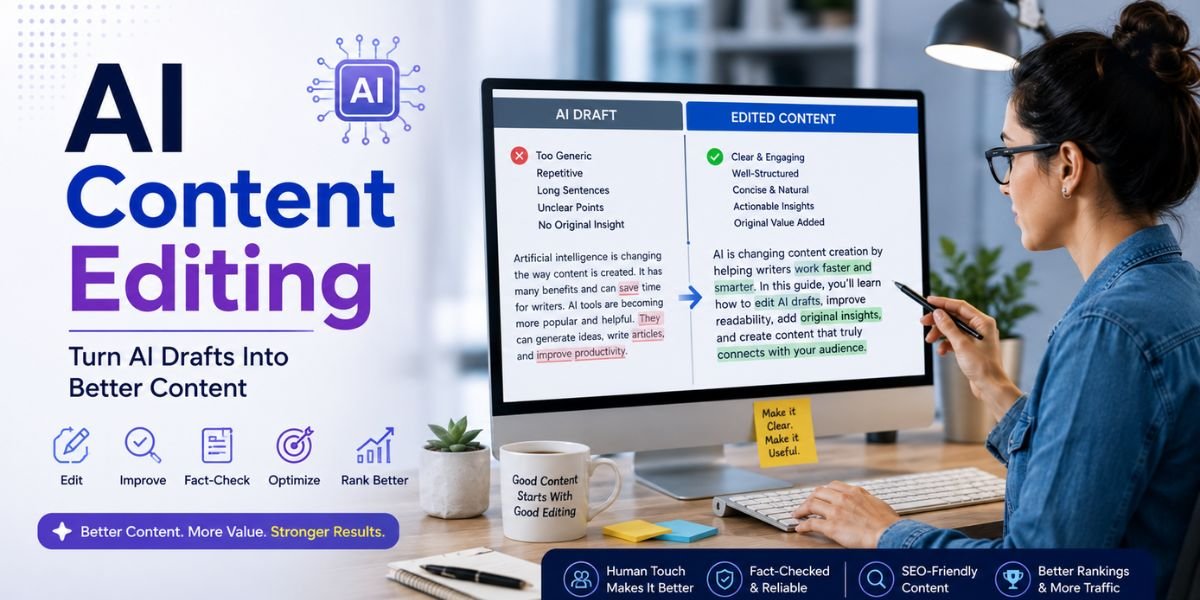
Do Not Publish Unedited AI Drafts
AI-generated content can contain:
- Incorrect facts
- Outdated information
- Repetitive language
- Generic examples
- Unsupported claims
- Missing context
Human review is essential.
Read the entire article before publication.
Add original information.
Verify important claims.
Improve the structure.
Remove unnecessary sections.
Make the content genuinely useful.
Don’t Chase AI SEO Hacks
There are many claims online about special methods for “ranking in AI Overviews.”
Be careful.
Google’s own 2026 guidance says traditional SEO best practices remain relevant and specifically addresses misconceptions around optimisation for generative AI features.
There is no reliable shortcut that guarantees inclusion.
Avoid Over-Optimisation
Do not:
- Repeat keywords excessively
- Create unnatural question sections
- Add fake statistics
- Stuff pages with entities
- Hide text
- Create unnecessary schema
- Publish large volumes of similar pages
- Copy competitors
- Write solely for AI systems
Focus on making the page useful.
That is a more sustainable strategy.
Write Content That Can Stand on Its Own
One of the best ways to prepare for Google AI Overviews is to create content that remains valuable even when users see only a short summary in Search.
If your page contains original information, detailed examples, useful comparisons, practical instructions, or unique research, the user has a reason to click.
Google says AI search experiences can show supporting links and provide opportunities for users to explore content across the web.
Give Readers a Reason to Visit
Imagine that Google already gives the user a two-sentence answer.
Why would they click your page?
Possible reasons include:
- Detailed tutorial
- Original research
- Product testing
- Comparison table
- Screenshots
- Expert analysis
- Case study
- Downloadable resource
- Unique examples
- Detailed recommendations
Build these advantages into your content.
Optimise for Long-Tail Searches

AI search encourages users to ask detailed questions.
Instead of searching:
“AI writing”
a user might ask:
“How can I use AI to write blog posts without losing my website’s Google rankings?”
Long-tail searches often reveal more specific intent.
Create Comprehensive Answers
Use your article to answer several related questions naturally.
For example, an article about AI content can address:
- Can AI content rank?
- Does Google penalise AI content?
- How should AI content be edited?
- How much original information should be added?
- Does AI content need disclosure?
- How does AI content affect SEO?
Do not create separate pages for every minor keyword if one comprehensive article can answer the questions better.
Keep Content Fresh
AI search is changing quickly, and information about Google’s features can become outdated.
Google’s Search documentation continues to receive updates. In 2026, Google added guidance on optimising for generative AI features, clarified information about llms.txt, and updated documentation around AI Overviews and AI Mode.
This means articles about Google AI Overviews should be reviewed regularly.
Update Outdated Information
Check:
- Google Search features
- SEO recommendations
- Structured data guidance
- Search policies
- Product information
- Screenshots
- Statistics
- Dates
- Examples
If an article says something that is no longer true, update it.
Do not simply change the publication date.
Update the actual information.
Monitor More Than Clicks
AI Overviews can change the relationship between impressions and clicks.
Google has said that clicks from AI Overviews can be higher quality, with users potentially spending more time on websites after clicking through. Google therefore encourages site owners to consider broader outcomes such as conversions, signups, engagement, and other valuable actions instead of focusing only on clicks.
Track Meaningful Results
Depending on your website, monitor:
- Organic traffic
- Engagement
- Time spent on site
- Leads
- Sales
- Email signups
- Affiliate clicks
- Downloads
- Returning visitors
A page with fewer clicks but stronger conversions may be more valuable than a page with high traffic and little engagement.
A Practical Workflow for Google AI Overviews
Creating content for AI Overviews does not need to be complicated.
Use a repeatable workflow.
Step 1: Choose a Valuable Topic
Pick a topic that matters to your audience.
Step 2: Research Search Intent
Understand what people want to accomplish.
Step 3: Analyse Existing Results
Look for gaps in current content.
Step 4: Build a Detailed Outline
Include the main question and relevant follow-up questions.
Step 5: Research Reliable Sources
Use official documentation, original research, and trustworthy references.
Step 6: Add Original Information
Include experience, examples, testing, analysis, or research.
Step 7: Write Clearly
Use natural language and descriptive headings.
Step 8: Optimise for SEO
Review the title, keywords, internal links, images, URL, and metadata.
Step 9: Add Structured Data When Appropriate
Make sure the markup accurately reflects visible content.
Step 10: Improve Page Experience
Check mobile usability, speed, readability, navigation, and intrusive elements.
Step 11: Check Indexability
Make sure Google can crawl and index the page.
Step 12: Review and Update
Monitor performance and refresh information when necessary.
Common Mistakes to Avoid
There are several mistakes website owners should avoid when learning How to Write for Google AI Overviews in 2026.
Writing Only for Keywords
Keywords are useful, but they should support the topic rather than control every sentence.
Copying Search Results
Rewriting the same information that already exists does not create a strong reason for users to visit your page.
Creating Fake Expertise
Never invent experience, testing, qualifications, or research.
Publishing Unedited AI Content
AI can assist with content creation, but human review remains important.
Using Excessive Schema
Structured data should accurately represent visible content. It is not a shortcut into AI Overviews.
Ignoring Technical SEO
Google must be able to access and index your page.
Focusing Only on Traffic
Measure conversions and engagement as well as clicks.
Chasing Every AI SEO Trend
Google’s own guidance is more straightforward: create unique, useful content and continue following strong SEO fundamentals.
Final Checklist for Google AI Overviews
Before publishing an article, ask:
- Does the article satisfy the main search intent?
- Does it answer the main question clearly?
- Does it cover useful follow-up questions?
- Is the information accurate?
- Is the content original?
- Does it contain first-hand experience where relevant?
- Does it provide more value than a basic summary?
- Are the headings descriptive?
- Is the primary keyword used naturally?
- Are related keywords included naturally?
- Are internal links useful?
- Are images relevant?
- Is alt text descriptive?
- Does structured data match visible content?
- Can Google crawl and index the page?
- Is the page mobile-friendly?
- Is the main content easy to find?
- Are important claims supported by reliable sources?
- Has unnecessary AI-generated text been removed?
- Would the reader find the page worth bookmarking or sharing?
If the answer is yes, your content has a much stronger foundation for traditional Google Search as well as AI-powered Search experiences.
Must Read:
- How to Use AI for Blog Writing Without SEO Problems?
- How to Humanize AI Content Without Losing SEO?
- AI Writing vs Human Writing: Which Is Better in 2026?
Final Thoughts:
Learning How to Write for Google AI Overviews in 2026 is not about finding a secret formula that forces Google to cite your website.
The most reliable strategy is to create content that deserves to be referenced.
Google’s current guidance says AI search experiences continue to rely on the same broad principles that have supported Search for years: useful, unique, satisfying content; strong technical accessibility; good page experience; accurate structured data; and content created for people.
Focus on search intent.
Answer questions directly.
Cover related questions naturally.
Add original research and first-hand experience.
Use keywords naturally.
Build useful internal links.
Optimise your technical SEO.
Keep structured data accurate.
Make your pages easy to read and navigate.
Most importantly, give readers information they cannot get from a generic summary.
Google’s guidance also makes clear that using AI to create content is not automatically a problem. Generative AI can assist with research and structure, but creating large amounts of pages without adding value can fall under Google’s scaled-content-abuse policies.
The future of search will continue to change, but the basic principle remains simple: create content that genuinely helps people.
If you build your website around that principle, your SEO strategy can remain useful across traditional Search, Google AI Overviews, AI Mode, and future search experiences.