Learning How to Create Original Content With AI is becoming increasingly important for bloggers, marketers, publishers, and website owners who want to use artificial intelligence without producing generic articles that look like everything else online. AI can help with brainstorming, research, outlining, drafting, editing, and content planning, but originality still requires human judgement and meaningful input.
The biggest mistake is treating AI as a machine that should create a complete article from a short prompt. That approach can produce content that is grammatically correct but repetitive, predictable, and similar to information already available on other websites. A better approach is to use AI as a creative assistant while you provide the experience, research, opinions, examples, and editorial direction.
Google’s current guidance says generative AI can be useful for researching topics and adding structure to original content. However, using AI to generate many pages without adding value can fall under its scaled-content-abuse policy. Google also says its Search systems aim to reward original, high-quality, people-first content regardless of whether AI was involved in its creation.
That makes How to Create Original Content With AI less about avoiding AI and more about learning how to use it responsibly. When you combine AI efficiency with human creativity, real experience, reliable research, and thoughtful editing, you can create content that is both useful and distinctive.
What Does Original Content Mean?
Original content is information that provides genuine value rather than simply repeating, rewriting, or rearranging information that already exists. It can include your own experience, research, analysis, examples, opinions, testing, observations, comparisons, or explanations.
Originality does not mean that every sentence must be completely new. Most articles discuss subjects that have already been covered elsewhere. The important point is whether your article contributes something useful to the conversation.
Google’s people-first guidance asks creators to consider whether their content provides original information, reporting, research, or analysis and whether readers will leave feeling that they learned enough to achieve their goal.
Originality Is More Than Changing Words
Simply rewriting another article with different words does not necessarily create original content.
For example, imagine ten websites explain what an AI website builder is.
If you use AI to rewrite those ten explanations and combine them into another article, the result may still provide very little new value.
Instead, you could test several AI website builders and compare:
- Setup time
- Design quality
- Editing options
- SEO features
- Mobile performance
- Pricing
- Ease of use
- Limitations
Now you are adding information that readers can use to make a decision.
Originality Can Come From Your Experience
You do not need to conduct a major scientific study to create original content.
Your experience can be valuable.
For example, if you have used an AI writing tool for six months, you can explain what worked, what did not, how your workflow changed, and what you would recommend to other bloggers.
That perspective can make an ordinary topic much more useful.
Use AI as a Creative Assistant
The best way to understand How to Create Original Content With AI is to think of AI as an assistant rather than the author of your entire article.
AI is excellent at generating possibilities.
You are responsible for deciding which possibilities are worth developing.
Use AI for:
- Brainstorming
- Topic exploration
- Content outlines
- Question generation
- Headline ideas
- Drafting
- Rewriting
- Summarising research
- Identifying missing sections
- Editing
- Content repurposing
Then add your own contribution.
Give AI Context Before Asking for Ideas
The quality of AI output improves when you provide detailed context.
Instead of asking:
“Give me blog ideas about AI.”
Tell the tool:
“My website focuses on AI website building and content creation. My audience includes bloggers, small business owners, and beginners. Suggest practical article ideas that solve specific problems rather than general AI topics.”
The second prompt gives AI a clearer understanding of your audience and content strategy.
This helps produce ideas that are more relevant to your website.
Start With a Unique Content Angle
One of the easiest ways to create original content with AI is to begin with a unique angle before generating the article.
The topic may already be common, but your approach can be different.
Suppose your topic is:
AI Writing Tools for Bloggers
Instead of writing another general list, you could choose an angle such as:
- Best AI writing tools for beginners
- Best AI tools for long-form blog posts
- Best AI writing tools for SEO
- AI writing tools tested by bloggers
- AI writing tools for affiliate websites
- Free AI writing tools compared
- AI writing tools for content updating
The topic remains familiar, but the purpose becomes more specific.
Ask What Makes Your Article Different
Before writing, complete this sentence:
“My article will be different because…”
Possible answers include:
- I tested the products myself.
- I compared actual features.
- I included original screenshots.
- I analysed current pricing.
- I interviewed experts.
- I used real examples.
- I collected data.
- I explain the subject for beginners.
- I focus on a specific audience.
If you cannot answer this question, your article may need a stronger angle.
Research Before Generating the Draft
AI can generate content quickly, but original content starts with good research.
Research gives you facts, context, examples, questions, and opportunities to provide something new.
Use Reliable Sources
For factual content, use trustworthy sources such as:
- Official documentation
- Government websites
- Academic research
- Industry organisations
- Original studies
- Company documentation
- First-party product information
For Google SEO topics, Google’s own Search Central documentation should be a primary reference.
Google’s Search Essentials recommends helpful, reliable, people-first content and encourages creators to use words their audience would actually search for while keeping content useful and well organised.
Do Not Let AI Replace Research
AI can help you identify what to research, but it should not be your only source for important facts.
For example, if AI says:
“Tool X increased productivity by 45%.”
Do not automatically include that statement.
Find the original source.
Check what was measured.
Check when the study was conducted.
Check whether the statistic applies to your audience.
This process improves both accuracy and originality.
Find Content Gaps
A content gap is an important question, problem, or piece of information that existing articles do not answer well.
Finding content gaps is one of the best ways to create original content with AI.
Look at existing articles and ask:
- What information is missing?
- Which explanations are unclear?
- Are the examples outdated?
- Is the article too general?
- Are practical steps missing?
- Are there no real-world examples?
- Does the article ignore beginners?
- Are limitations discussed honestly?
Then use AI to help organise your ideas around those gaps.
Create Better Answers Instead of Longer Articles
Do not assume that originality requires more words.
A focused 1,500-word article with useful research can be more valuable than a 4,000-word article filled with generic explanations.
Google says there is no preferred word count for ranking. The focus should be on satisfying the reader and providing substantial value.
The goal is not to write the longest article.
The goal is to write the most useful article for the intended reader.
Add First-Hand Experience

First-hand experience is one of the strongest ways to create original content.
AI can describe how a product works.
You can explain what happened when you actually used it.
For example, if you are reviewing an AI website builder, record your experience:
- How long did registration take?
- How quickly did the AI create the first website?
- Was the generated content useful?
- How easy was editing?
- Could you change colours and fonts?
- Were SEO settings available?
- How did the website look on mobile?
- What limitations did you notice?
These details create content that is much harder to duplicate.
Show Your Process
Screenshots, examples, and step-by-step explanations can make first-hand content even stronger.
Instead of saying:
“AI website builders are easy to use.”
Show readers what the process actually looks like.
Explain the steps.
Show the interface.
Mention where you experienced problems.
Explain how you solved them.
This turns a generic claim into useful evidence.
Add Original Examples
Examples make AI-assisted content more distinctive.
Suppose you are writing about AI blog writing.
Instead of saying:
“Use a detailed prompt.”
Show an example.
Weak Prompt
“Write a blog about SEO.”
Better Prompt
“Create an outline for a beginner-friendly article explaining how small business owners can optimise blog posts for Google. Include search intent, keyword research, internal links, title optimisation, content structure, and common SEO mistakes.”
Then explain why the second prompt produces a more useful result.
Examples like this teach readers something instead of simply telling them what to do.
Add Your Own Analysis
Analysis is another powerful source of originality.
AI can summarise information, but you can interpret it.
For example, suppose you compare three AI writing tools.
Instead of simply listing their features, explain:
“Tool A is better for beginners because the interface is simpler, while Tool B offers stronger SEO controls but requires more setup. Tool C is more suitable for teams because of its collaboration features.”
That interpretation helps readers make decisions.
Explain the “Why”
Do not only describe what something does.
Explain why it matters.
For example:
“An AI writing tool with brand voice controls can be useful for publishers managing several writers because it helps maintain a consistent tone across articles.”
The explanation adds context and makes the content more useful.
Create Original Research
You can also use AI to help organise your own research.
Original research might include:
- Surveys
- Interviews
- Product tests
- Website experiments
- Pricing comparisons
- Performance measurements
- Reader polls
- Case studies
- Data analysis
AI can help analyse the information, identify patterns, create tables, or organise findings.
But the underlying data should be genuine.
Use AI to Analyse Your Data
Suppose you collect responses from 100 bloggers about how they use AI.
AI can help you:
- Categorise responses
- Identify common themes
- Summarise open-ended answers
- Create tables
- Suggest visualisations
- Identify interesting patterns
You then explain the results in your own article.
That creates a stronger form of original content than asking AI to generate generic blogging advice.
Use AI to Generate Questions, Not Just Answers
Another effective technique for How to Create Original Content With AI is asking AI to generate questions that readers may have.
For example:
“What questions would a beginner ask after learning how to create AI-generated content?”
AI might suggest:
- Can AI content rank on Google?
- How can I add personal experience?
- How do I check AI-generated facts?
- How can I make AI writing sound natural?
- Should I disclose AI use?
- How much editing is necessary?
These questions can reveal areas you need to cover.
Think Like the Reader
After generating questions, review them yourself.
Some may be irrelevant.
Others may reveal valuable topics you had not considered.
Choose questions based on your audience rather than automatically including everything AI suggests.
Avoid Copying Competitors With AI
One of the biggest mistakes is using AI to rewrite competing articles.
This can produce content that looks different but communicates the same information.
That is not a strong originality strategy.
Build From Research Instead
Research the topic from multiple reliable sources.
Then create your own structure.
Add your own examples.
Use your own analysis.
Include original data where possible.
This approach produces content that reflects your editorial viewpoint rather than copying the structure of another website.
Google’s SEO Starter Guide recommends creating content yourself rather than copying or simply rehashing information already published elsewhere.
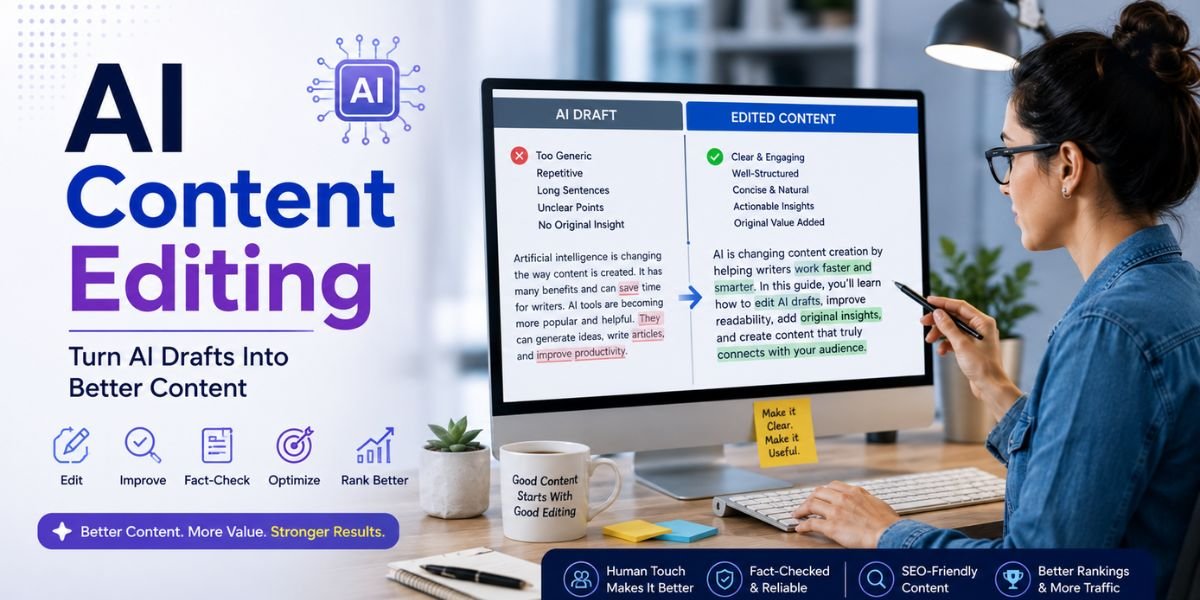
Humanise AI-Generated Content
AI-generated content can sometimes sound repetitive or predictable.
Human editing makes a major difference.
Look for:
- Generic introductions
- Repeated phrases
- Overly formal language
- Long sentences
- Weak transitions
- Unnecessary summaries
- Vague claims
- Repetitive conclusions
Then rewrite the sections that need improvement.
Use a Consistent Brand Voice
Your website should sound like your website, not like a generic AI assistant.
Define your preferred:
- Tone
- Vocabulary
- Sentence style
- Paragraph length
- Level of detail
- Writing personality
- Audience
For example, a technology blog might prefer clear, professional, conversational language.
A personal blog might use a more relaxed tone.
Feed those guidelines into your AI prompts and then edit the output manually.
Make Your Content More Specific

Specificity is one of the easiest ways to improve originality.
Compare:
“AI can help bloggers save time.”
with:
“AI can reduce the time spent creating an article outline, generating headline ideas, rewriting repetitive paragraphs, and preparing a first draft.”
The second sentence provides more useful information.
Replace Vague Claims
During editing, look for phrases such as:
- “Many people”
- “A lot of businesses”
- “Huge benefits”
- “Amazing results”
- “Very effective”
- “In today’s world”
Ask:
Who? How many? Why? How?
If you cannot answer, either provide evidence or rewrite the claim.
Specific content feels more credible and informative.
Optimise Original Content for SEO
Originality and SEO should work together.
Creating original content does not mean ignoring keywords.
Google’s Search Essentials recommends using relevant words that people use to search for your content in prominent locations such as titles and main headings, while also using them naturally throughout the page.
Use the Focus Keyword Naturally
For this article, the focus keyword is:
How to Create Original Content With AI
Use it naturally in:
- Title
- Introduction
- Relevant headings
- Body content
- Meta title
- Meta description
Do not repeat the exact keyword in every paragraph.
Natural usage is more readable.
Use Related Terms
Related phrases can help establish topical relevance.
For this topic, useful terms include:
- AI content creation
- original AI content
- AI-generated content
- AI writing tools
- human editing
- content originality
- AI-assisted writing
- SEO content
- people-first content
- content strategy
- original research
- AI content editing
- search intent
- content quality
Use these phrases when they fit naturally.
Optimise for Search Intent
Search intent describes what someone expects to find after entering a query.
For How to Create Original Content With AI, the reader likely wants practical guidance.
They may want to know:
- How AI can help with originality
- How to avoid generic AI content
- How to add personal experience
- How to research topics
- How to create unique examples
- How to use AI without SEO problems
- How to edit AI drafts
- How to create people-first content
Make sure your article answers these questions.
Give the Reader a Clear Process
A step-by-step approach is particularly useful for a “how to” query.
For example:
Research → Find a gap → Create an angle → Use AI for ideas → Add original information → Draft → Edit → Fact-check → Optimise → Publish
This gives the reader a process they can actually follow.
Use AI for Content Outlines
AI is particularly useful for creating content outlines.
Give it your topic, audience, search intent, and unique angle.
Then ask it to suggest a structure.
After that, modify the outline yourself.
Do Not Accept the First Outline
AI may produce a predictable structure.
Look for opportunities to improve it.
Ask:
- Does the order make sense?
- Is anything unnecessary?
- Is anything missing?
- Does the outline match search intent?
- Where can I add original information?
- Where can I include examples?
Your final outline should reflect your content strategy.
Create Better Prompts for Original Content
Prompt quality has a significant impact on AI output.
Instead of:
“Write an original article about AI.”
try:
“Help me create an article for beginner bloggers who want to use AI without producing generic content. Suggest practical ways to add original research, personal experience, unique examples, expert insights, comparisons, and data. Avoid making unsupported claims or inventing experiences.”
This tells AI what originality should mean for the article.
Ask AI to Challenge Your Ideas
AI can also be useful as a critic.
After creating an outline, ask:
“What parts of this article are likely to sound generic or similar to existing content? Suggest ways to add original information.”
This can reveal weaknesses before you begin writing.
Fact-Check AI Content
Originality is not enough if the information is wrong.
Every AI-assisted article should go through a fact-checking process.
Verify Important Claims
Check:
- Statistics
- Dates
- Prices
- Product information
- Technical details
- Research
- Company information
- Google policies
Use primary sources where possible.
For example, if your article discusses Google’s AI content policies, check Google’s current Search Central documentation instead of relying on an AI-generated explanation.
Google’s own guidance says content should focus on accuracy, quality, and relevance, including when AI is used to generate content.
Add Author Expertise
Your author information can support trust and transparency.
Where appropriate, provide an accurate author byline and explain relevant experience.
For example, if an article discusses blogging, the author profile could mention experience in content creation, SEO, publishing, or digital marketing.
Explain How AI Was Used
Google says disclosures about AI or automation can be useful when readers might reasonably ask how the content was created. It also recommends considering context about how automation was used when it substantially contributes to content creation.
This does not mean every article needs a large AI disclaimer.
Consider what your readers would reasonably want to know.
Transparency can be especially useful when automation plays a substantial role.
Avoid Scaled Low-Value AI Content
Creating original content with AI is very different from generating hundreds of pages automatically.
Google’s spam policies define scaled content abuse as creating many pages primarily to manipulate search rankings rather than help users. The policy specifically lists using generative AI to generate many pages without adding value as an example.
Quality Should Control Publishing Volume
Do not publish an article simply because AI has finished generating it.
Before publication, ask:
- Is this useful?
- Is it accurate?
- Is it original?
- Does it satisfy search intent?
- Does it provide something readers cannot easily get elsewhere?
- Did I add meaningful human input?
If the answer is no, improve it before publishing.
Create Original Visual Content
Originality is not limited to written text.
You can make your articles more distinctive with original visuals.
Consider creating:
- Screenshots
- Charts
- Diagrams
- Comparison tables
- Infographics
- Before-and-after examples
- Original illustrations
- Process diagrams
Use Images to Explain Ideas
Do not add an image just because every article needs one.
The visual should support the information.
For example, an article about AI content creation could include a diagram showing:
Topic → Research → AI Assistance → Human Input → Editing → Fact-Checking → SEO → Publishing
That visual communicates the workflow quickly.
Build Topic Authority Naturally
Original content becomes more powerful when it forms part of a focused website.
Instead of publishing random AI articles, create related content around a clear subject.
For example, an AI content category could include:
- How to Create Original Content With AI
- How to Humanise AI Content
- AI Content Editing
- AI Writing Tools for Bloggers
- How to Use AI for Blog Writing
- How AI Content Affects SEO
- Google AI Overviews
- AI Content Optimisation
Then connect these articles with relevant internal links.
Create Content Clusters
A content cluster helps your website cover a subject from different angles.
One broad article can act as a central resource.
Supporting articles can answer specific questions.
This gives readers more opportunities to explore the topic while creating a more organised website structure.
Update AI-Assisted Content Regularly

AI content can become outdated just like human-written content.
Information about:
- AI tools
- Pricing
- Features
- Google Search
- SEO recommendations
- Software
- Industry trends
can change quickly.
Refresh the Actual Information
When updating an article, check:
- Statistics
- Examples
- Screenshots
- Links
- Product features
- Pricing
- Recommendations
- Search guidance
Do not simply change the date.
Google recommends keeping content up to date and updating older content when needed. Its SEO guidance also emphasises useful, unique, reliable information.
A Practical Workflow for Creating Original Content With AI
You can turn everything above into a repeatable process.
Step 1: Choose a Real Audience Problem
Start with something your audience actually needs.
Step 2: Research the Topic
Use reliable sources and understand the existing information.
Step 3: Identify a Content Gap
Find something existing articles do not explain well.
Step 4: Choose Your Unique Angle
Decide what will make your article different.
Step 5: Ask AI for Ideas
Use AI for brainstorming and questions.
Step 6: Create the Outline
Build a logical structure around search intent.
Step 7: Add Your Own Information
Include experience, research, examples, opinions, or analysis.
Step 8: Generate a Draft
Use AI to speed up the writing process.
Step 9: Edit the Content
Remove repetition and improve clarity.
Step 10: Fact-Check
Verify important information.
Step 11: Optimise for SEO
Review keywords, headings, internal links, images, metadata, and search intent.
Step 12: Add Original Visuals
Use screenshots, diagrams, charts, or other useful media.
Step 13: Perform a Reader Review
Ask whether the article genuinely solves the reader’s problem.
Step 14: Publish and Monitor
Track performance and update the content when needed.
Common Mistakes to Avoid
Creating original content with AI becomes much easier when you know what not to do.
Do Not Ask AI to Copy Competitors
Use competitor research to identify gaps, not to reproduce their articles.
Do Not Publish Raw AI Drafts
A generated draft should normally go through human review.
Do Not Invent Personal Experience
Authenticity cannot be generated through a prompt.
Do Not Create Fake Research
Never invent surveys, statistics, quotes, or studies.
Do Not Stuff Keywords
Use SEO naturally.
Do Not Write Only for Google
Google’s people-first guidance specifically warns against creating content primarily to attract search engine visits.
Do Not Publish at Scale Without Quality Control
Large-scale AI publishing without meaningful value can create spam-policy risks.
Final Checklist for Original AI Content
Before publishing, review your article using this checklist.
Originality
- Does the article add something new?
- Did I include original examples?
- Did I add personal experience where relevant?
- Did I include original research or analysis?
- Is the content more than a rewritten version of another article?
Quality
- Is the information accurate?
- Is the article easy to read?
- Does it answer the main question?
- Are unnecessary sections removed?
- Are important claims supported?
SEO
- Is the focus keyword relevant?
- Is it used naturally?
- Does the title accurately describe the page?
- Are H2 and H3 headings useful?
- Are internal links relevant?
- Is the meta description accurate?
- Are images helpful?
Reader Value
- Does the article solve a real problem?
- Would readers learn something useful?
- Is there a clear next step?
- Does the article provide more value than a generic AI summary?
Must Read:
- AI Content Editing: Turn AI Drafts Into Better Content
- How to Create High-Quality Blog Content With AI?
- 10 Best AI Writing Tools for Bloggers in 2026
Final Thoughts:
Learning How to Create Original Content With AI does not require choosing between artificial intelligence and human creativity. The strongest approach combines both.
Use AI to brainstorm ideas.
Use it to research questions.
Use it to create outlines.
Use it to generate a first draft.
Use it to identify weaknesses.
But bring your own experience, research, examples, analysis, opinions, and editorial judgement to the final article.
Google’s current guidance is clear that AI itself is not the problem. Google says generative AI can be useful for research and adding structure to original content, while its systems aim to reward original, high-quality, people-first content.
The real risk comes from creating content without meaningful value. Google’s scaled-content-abuse policy specifically identifies generating many pages with AI without adding value as an example of problematic behaviour.
That is why originality should be built into your workflow from the beginning.
Start with a real audience problem.
Research the subject.
Find a content gap.
Choose a unique angle.
Use AI for assistance.
Add genuine human input.
Fact-check the information.
Edit the writing.
Optimise naturally for SEO.
Then ask the most important question:
“Would this article still be useful if Google did not send me any traffic?”
If the answer is yes, you are much closer to creating people-first content that has genuine value.
The future of blogging is not about producing the most AI-generated content. It is about using AI to help you produce better original content more efficiently. When technology handles repetitive tasks and humans provide creativity, experience, judgement, and trust, AI becomes a powerful part of a sustainable content strategy.